Public Speaking for the Socially Anxious

I still remember the exact feeling of my palms turning into literal swamps during my first big client presentation last year. I was sitting in my home office, staring at a Zoom grid of expectant faces, feeling like my throat had been replaced by a handful of dry sand. Most of the public speaking tips I found online at that moment were completely useless—they told me to “visualize success” or “embrace my inner leader,” which felt about as helpful as telling a person in a storm to just imagine they were dry. I didn’t need a spiritual awakening; I needed to know how to stop my voice from cracking when I hit the three-minute mark.
I’m not here to tell you how to become a TED Talk sensation or a master orator overnight. Instead, I want to share the small, tactical adjustments that actually helped me get through those shaky first few meetings without losing my mind. We’re going to skip the fluff and focus on a few low-stakes habits that make communicating your ideas feel less like a performance and more like a conversation. Let’s figure out how to handle the nerves so you can get back to the work that actually matters.
How to Structure a Speech Without Overthinking It

Look, I used to think that a great speech required a complex, multi-layered narrative arc that would make a screenwriter weep. In reality, when you’re staring down a deadline or a sudden meeting invite, that kind of perfectionism is just a recipe for paralysis. The secret to learning how to structure a speech without losing your mind is to stop trying to be Shakespeare and start being a guide. I like to use a simple three-part framework: one clear problem, one actionable solution, and one “so what?” moment. If you can anchor your thoughts to those three pillars, you won’t find yourself wandering aimlessly through your slides.
The goal isn’t to memorize a script word-for-word—that’s how you end up sounding like a robot or, worse, completely blanking when you lose your place. Instead, I treat my outline like a roadmap rather than a cage. I jot down key bullet points in my physical notebook, focusing on the transitions between ideas. If you know exactly how you’re getting from point A to point B, you’ll naturally feel more confident in your delivery. This approach makes public speaking for professionals feel less like a high-stakes performance and more like a structured conversation. Keep it lean, keep it logical, and let the structure do the heavy lifting for you.
Small Habits for Mastering Effective Body Language for Speakers
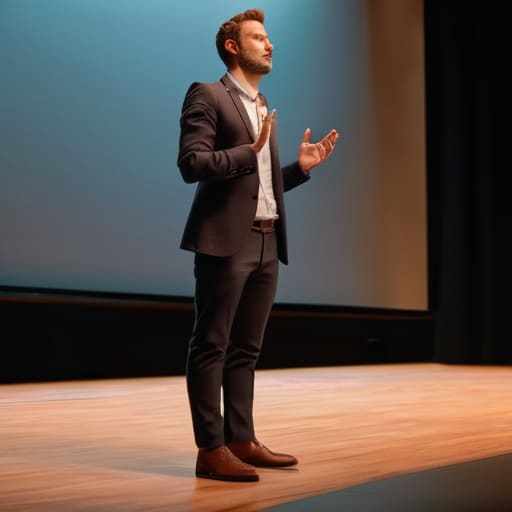
I used to think that being a “good speaker” meant having these grand, sweeping gestures like I was performing in a Shakespeare play. In reality, that just looks awkward and makes you look like you’re fighting invisible bees. For me, mastering effective body language for speakers started with the small, grounding stuff. I started focusing on my stance—planting my feet about shoulder-width apart and resisting the urge to do the “nervous sway.” It sounds incredibly basic, but when you stop treating your body like a fidget spinner, you suddenly have much more energy to focus on your actual message.
Another thing that changed the game for me was learning to use my hands as punctuation rather than just moving them aimlessly. Instead of keeping them shoved in my pockets or gripped tight around a laser pointer, I try to use open palms to emphasize key points. It’s a subtle way of engaging an audience during presentations without feeling like you’re putting on a theatrical performance. If you’re feeling the heat, just remember: keep your hands visible, keep your shoulders down, and try to make eye contact with one person at a time. It makes the room feel a lot smaller and way less intimidating.
Five ways to stop the spiral before you step up
- Stop trying to memorize a script word-for-word. When you do that, the second you trip over a sentence, your brain enters a full-blown panic mode. Instead, just memorize your key “anchor points”—the main ideas you need to hit—and let the sentences happen naturally. It feels less like a performance and more like a conversation.
- Use the “Power of the Pause” to kill the filler words. We all do it—the ums, ahs, and likes—usually because we’re afraid of silence. But silence actually makes you look like you’re in control. If you lose your train of thought, just stop. Take a breath. It looks intentional to the audience, even if your heart is racing.
- Find your “friendly faces” in the crowd. Staring at a sea of blurry eyes is intimidating. Instead, pick three people—maybe one on the left, one in the middle, and one on the right—who look like they’re actually nodding or smiling. Rotate your eye contact between them. It turns a room full of strangers into a small, manageable chat.
- Treat your voice like a tool, not a monotone drone. If you speak at one constant volume and speed, people will tune out by minute three. Vary your pace. Slow down when you’re saying something important, and let your energy lift when you’re making a point. It keeps people leaning in.
- Do a “low-stakes” warm-up. You wouldn’t run a marathon without stretching, so don’t walk onto a stage cold. Talk out loud to yourself in the car, or even just hum a little bit to get your vocal cords moving. Getting the sound out of your body before the “real” moment takes a massive amount of the edge off.
The Tuesday-Proof Checklist
Stop trying to memorize a script word-for-word; instead, just master your “anchor points” so you can stay conversational even if you lose your place.
Focus on your hands and your feet before you worry about your facial expressions—steadying your physical base naturally calms your nervous system.
Treat every small meeting or casual presentation as a low-stakes practice run, because confidence is just a collection of tiny, successful repetitions.
The Tuesday Takeaway

At the end of the day, public speaking isn’t about delivering a flawless, cinematic performance that leaves people breathless. It’s really just about having a solid structure so you don’t lose your place, and using your body to signal that you’re actually present in the room. If you can nail a simple outline and remember to breathe through the pauses, you’ve already done the heavy lifting. Don’t get hung up on the tiny stumbles or the moments where your hands shake a little; those are just part of the process. Focus on the small, repeatable wins like steady eye contact and a clear opening, and the rest will eventually settle into place.
I know how it feels to stand there with your heart hammering against your ribs, wishing you could just disappear into the floorboards. But remember, nobody is looking for perfection—they’re just looking for a connection. You don’t need to reinvent your entire personality to be a “great speaker.” You just need to show up, share what you know, and be human. Public speaking is a muscle, and like any skill, it only gets stronger when you stop overthinking the mechanics and start trusting the habit. You’ve got this. One Tuesday at a time.